

The most important breakthroughs often begin before there is a market to fund them, a field to organize them, or an institution to back them.
They may start as a primitive that only a few researchers understand, a protocol that lacks a deployment path, a scientific result with no obvious business model, a regulatory gap that prevents adoption, or a community of builders who can see the future before capital knows how to underwrite it.
This stage is difficult for traditional institutions to support. Academic labs can produce deep insight, but often lack the infrastructure, capital, and deployment channels to turn that insight into widely used systems. Venture capital can scale companies, but usually enters after a market becomes legible. Governments can set standards, create demand, and fund ambitious work, but often move after a frontier has already taken shape. PL Research & Development (PL R&D) exists for the stage in between fundamental research and venture creation.
What is PL R&D
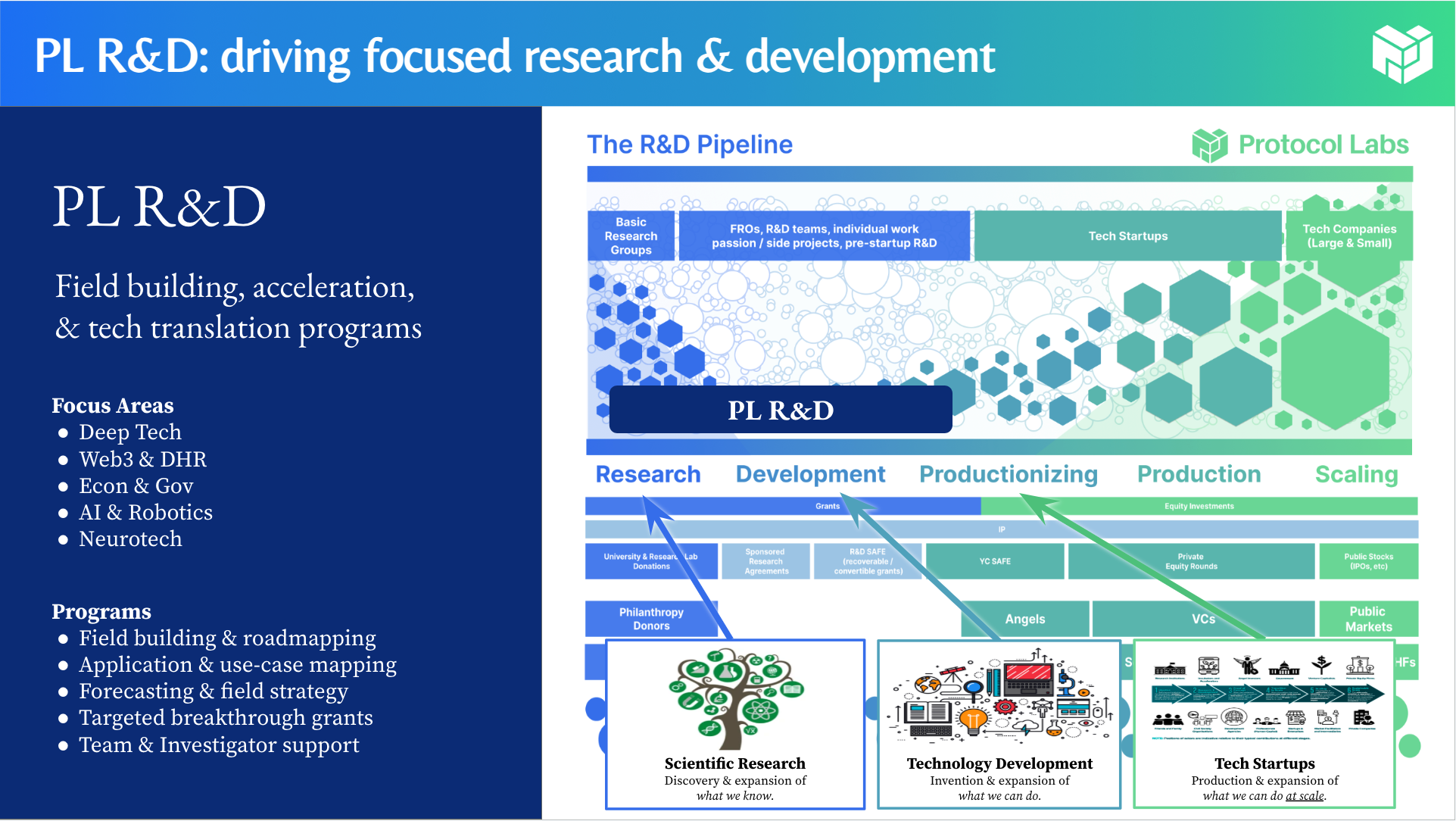
PL R&D is the field-building arm of the Protocol Labs (PL) innovation network. We map frontier computing fields, identify the bottlenecks blocking progress, and coordinate the research, funding, infrastructure, talent, and deployment pathways that help breakthroughs reach the world.
Our mission is to accelerate computing breakthroughs that expand human freedom, coordination, intelligence, and cognition. We do that through our focus areas:
Open, verifiable, censorship-resistant infrastructure for human freedom and agency in the digital age.
Programmable infrastructure for more effective coordination among individuals, institutions, markets, and states.
Open compute, data, coordination, and economic rails for autonomous agents and embodied AI.
Brain-computer interfaces, whole-brain emulation, and NeuroAI systems that can expand human cognition safely and responsibly.
PL R&D exists to help these fields accelerate faster.
How we choose opportunities
To shape strategy and interventions within opportunity spaces and inflection points, each focus area is stewarded by a Focus Area Lead and advised by its own Scientific Advisory Board of field experts. Together, they identify the field bottlenecks that can have the greatest impact, and the tools to use to unblock progress. We begin with a field-level question: What would need to be true for this field to progress much faster?
To answer this question, we organize each focus area into a small number of opportunity spaces – ARIA's term for "critically important but underexplored areas of research that we believe are ripe for breakthroughs". Within each opportunity space, we identify inflection points: specific, observable milestones that indicate a field has crossed an important threshold that lifts progress and momentum onto a new trajectory.
Inflection points can be technical demonstrations that shift the Overton window, adoption thresholds for new technologies, or another specific milestone that shapes field policy, legitimacy, access, or resources. The point is to be explicit about what we think will matter, what evidence would prove it, and what bottlenecks stand in the way. Once we identify the bottleneck, we can choose the intervention.
How we accelerate fields
Much of today's most promising frontier work struggles to find a home: it is often too early, too interdisciplinary, or too radical for traditional capital. Even when funding exists, the primary bottleneck is frequently a lack of coordination.
PL R&D bridges this gap. Rather than making discoveries ourselves, we create the conditions for discovery to thrive. We bring researchers, builders, funders, and institutions together to align on technical primitives, open infrastructure, and deployment pathways. Because every field faces unique obstacles, we deploy a versatile toolkit to unlock progress:
- Legibility – Field-building communications. Many early fields are blocked by illegibility - to both internal and external audiences. The progress is real, but the map is missing. Researchers cannot easily find adjacent teams. Founders cannot tell which problems are ready for company formation. Funders cannot distinguish noise from signal. Policymakers cannot see which interventions would help rather than slow progress. Written artifacts like a field map, taxonomy, roadmap, whitepaper, benchmark, policy brief, or public research agenda can turn a loose collection of teams, researchers, and funders into a field with sustained momentum.
- Connection – Convenings & gatherings. Some bottlenecks are social instead of technical. The right talent may already exist to unlock a breakthrough, but the field has not yet connected them. PL R&D runs and supports convenings, retreats, workshops, residencies, hackathons, and advisory networks that bring high-context people together around specific bottlenecks. The goal is not to host events, but to forge new collaborations, companies, grants, pilots, and enable shared roadmaps to emerge.
- Funding – Grants & prizes. Many important ideas are too early for venture capital and too applied for traditional academic funding. Some need small grants to test whether a primitive works. Others need prizes, RFPs, fellowships, or retroactive funding to pull effort into an underbuilt area. PL R&D deploys and helps coordinate early funding where a field-level bottleneck is clear and where small early funding can unlock much larger downstream effort.
- Policy – Standards & regulatory engagement. Frontier technologies often reach a point where the rules do not yet recognize what is possible. That can block adoption even when the technology works. In those cases, progress may require standards bodies, regulatory sandboxes, procurement pathways, model frameworks, or partnerships with public institutions. PL R&D engages in research, thought leadership, and participation in policy and standards-setting discussions with the goal of creating better rules, which, in turn, help responsible technologies reach users faster.
- Infrastructure – Primitives & rails. Sometimes the missing piece is open protocols, public-good infrastructure, or neutral rails that no single company has sufficient incentive to build alone. When a missing primitive or shared infrastructure layer is blocking a field, PL R&D may help build it directly, support the teams building it, or coordinate an ecosystem capable of maintaining it over time.
- Translation – Venture conversion. Some work reaches the point where the bottleneck is no longer research but translation into pilot, production, and scale. PL R&D connects projects within the broader Protocol Labs network - including venture, capital, platform, and ecosystem support - to help promising work find the right deployment path, talent, and resources to succeed.
Effective field-building is itself an open research domain, so part of our work will be refining new types of interventions. Over time, PL R&D aims to innovate not only within our focus areas - but in how R&D itself accelerates field progress faster.
How we measure success
Ultimately, the success of PL R&D is the success of our focus areas and the breakthroughs they create over time. As we reflect on our impact in accelerating progress, we use three questions to measure our own success in each focus area:
The first two questions are about the world. The third is about attribution. We will not always have clean answers, but we can be explicit about our hypotheses, our evidence, and where we were wrong.
Over time, we intend to publish progress against each field: the opportunity spaces we chose, the inflection points we tracked, the interventions we ran, the evidence for and against our contribution, and what we learned.
Our impact so far
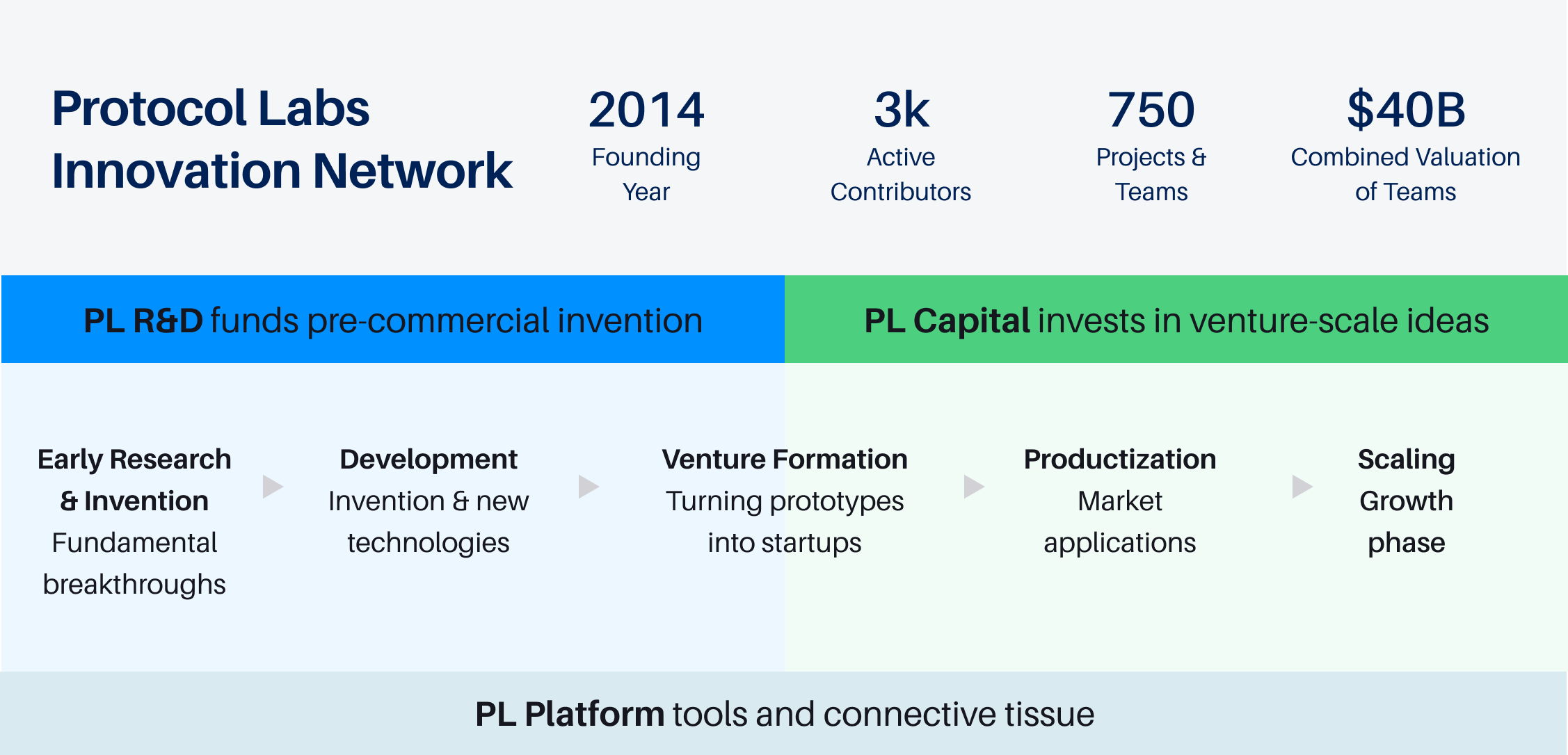
Protocol Labs was founded in 2014 by Juan Benet as a research, development, and deployment lab for network protocols. The premise was simple: many breakthroughs fail to matter because the gap between research and deployment is too large.
PL's first decade focused on the decentralized web. That work helped produce IPFS, Filecoin, libp2p, IPLD, and Multiformats: open infrastructure for addressing, storing, verifying, moving, and organizing information across distributed networks. Our R&D work helped establish content addressing as a standard with papers, protocols, implementations, developer adoption, storage markets, and a community that could carry the work forward; peer-to-peer networking with reusable libraries rather than every team rebuilding the same stack; and cryptographic infrastructure via production systems that forced theoretical primitives to become efficient enough for real-world use.
PL R&D is now applying that operating philosophy to the next set of fields where computing will shape civilization most directly: digital rights, economic coordination, machine intelligence, and human cognition.
In Digital Human Rights, 381 teams are active in the network, supported by more than $30M in grants in 2025, with convenings from the Cypherpunk Retreat to a d/acc Residency in Patagonia seeding the next generation of censorship-resistant infrastructure and agentic builders.
In Economies & Governance, more than 22,000 researchers, builders, and residents from over 80 nations are working on coordination problems nation-states cannot solve alone. Crecimiento brought DevCon 2025 to Buenos Aires (14,000 attendees, over 1,000 startups, more than $20M raised) alongside Regulation Day, which convened 1,500 regulators and lawmakers around crypto-native governance.
In AI & Robotics, open and distributed compute reached frontier scale: Prime Intellect trained a 100B+ parameter model via decentralized compute that rivals centrally-trained alternatives, EQTY Lab shipped a verifiable-compute layer on Nvidia's Blackwell platform, and BitRobot released HIW-500 - the largest open-source humanoid teleoperation dataset collected in real homes. Together, these form components of the agent-coordination infrastructure the next generation of AI deployment depends on.
In Neurotechnology, $2M in grants funded 9 teams in 2025. The BCI (brain-computer interface) Founders Retreat convened 9 leading teams whose companies have collectively raised billions in venture capital; the Connectomics Workshop advanced the mapping of brains for compute, emulation, and consciousness research; and PL Neuro launched as the field's organizing infrastructure, with whitepapers, roadmaps, and a public brand at plneuro.xyz, making a nascent field legible and recruitable for the first time.
We are pointing this approach at emerging fields because it has already worked in the ones PL knows best. The two case studies below show what this looked like in practice:
How the PL model compounds
PL R&D is designed to create leverage for many different stakeholders within the wider Protocol Labs innovation network. A good field map can help researchers orient their work, help founders find company ideas, help funders deploy grants and other capital more intelligently, and help institutions understand where policy or procurement can accelerate progress. A well-timed grant can create the proof point that makes a company fundable, while a gathering of the right minds can create the trust needed to scale a pilot. Shared infrastructure and primitives can help many teams build faster than they could alone.
The primary measure of success for PL R&D is whether a field accelerates. But durable institutions also need durable funding models, and one advantage of the Protocol Labs innovation network is the ability to connect multiple stages of the pipeline. PL connects early invention, expert talent, venture formation, and long-term capital into a compounding loop that can create sustainable funding sources for the next generation of R&D breakthroughs. Within the network, aligned cofounders like PLVS help turn validated breakthroughs into companies, while venture funds like PL Capital back extraordinary founders scaling breakthrough R&D. Founders we have supported have proceeded to raise more than $1B from angels & VCs across our investor network. From early invention to large-scale growth, the PL Platform helps ambitious projects reach the users, contributors, and markets they need to cross the chasm.
The risks we're managing
Our model is ambitious, and it should be evaluated seriously.
We see several risks: We could spread ourselves too thin across too many fields. We could choose familiar interventions instead of the ones a bottleneck actually requires. We could publish maps and host convenings without moving the underlying bottlenecks. We could fail to measure attribution well enough to learn and iterate. We could produce useful work that does not reach the researchers, founders, funders, and institutions who need it.
Instead of shrinking from risk - we face it head on by being precise about our hypotheses, public about progress, open to criticism, and willing to update our thinking. Frontier R&D is itself an evolving field. We expect to learn as much about how to run this kind of organization as we do about digital human rights, governance, AI, robotics, and neurotechnology.
How to work with PL R&D
PL R&D is built for collaboration.
Researchers - we want to hear where your field is blocked, what primitives are missing, what research directions deserve more attention, and what would help your work reach deployment. We can connect your expertise to field maps, grant programs, and talent gaps, and shape the path from research to deployment.
Founders & builders - our field-mapping can help inform which opportunity spaces are ripe for innovation, how new businesses can unlock field bottlenecks, which expert talent can help accelerate breakthroughs, and how open infrastructure can support new products and markets.
Funders, LPs, & philanthropists - PL R&D can help make frontier fields more legible, identify high-impact funding opportunities, and coordinate capital around shared bottlenecks.
Institutions, policymakers, & standards bodies - our field experts can help inform the rules, pilots, procurement pathways, and standards that help responsible technologies reach the world.
Protocol Labs network members - PL R&D is a way to connect your work to deeper field strategy: the opportunity spaces, inflection points, and infrastructure that can make your efforts compound.
Please get in touch with us at research@protocol.ai or follow us on X or Bluesky to continue the conversation.
What comes next
This post kicks off the PL R&D blog because it explains the operating model behind our work.
The next posts will go deeper into each focus area: Digital Human Rights, Economies & Governance, AI & Robotics, and Neurotechnology. Each will describe the opportunity spaces we see, the inflection points we think are within reach, the bottlenecks blocking progress, and the teams already pushing the frontier forward.
Our aim is to make frontier computing fields easier to understand, easier to fund, easier to build in, and easier to steer toward human flourishing. That is the work of PL R&D - and we hope you'll join us.
This post is for informational purposes only. It is not an offer, solicitation, or recommendation of any security or investment product, and nothing here is a commitment or guarantee of any future performance or any outcome.